Many Singapore parents wonder whether their child should start piano at 3, 4, 5, or later. This guide explains how early children can begin, how play-based music differs from formal piano lessons, and the signs that a child is ready.
It also explains what parents in Bukit Timah should look for when choosing an age-appropriate piano programme.
How early should a child start piano lessons?
There is no single age that works for every child.
Some children are ready for structured piano learning at 4 or 5. Others benefit from starting with music and movement classes first, then moving to the piano when they are older. And starting at 7 or 8 does not mean a child has missed their opportunity.
The better question is not simply, “What is the youngest age to learn piano?”
It is:
“What type of music learning is right for my child at their current stage?”
For parents in Bukit Timah, Singapore, there are programmes designed for very young children as well as more structured piano lessons for older beginners. Gail’s Piano Studio, for example, offers play-based music classes from 18 months and piano-based classes from around age 4.
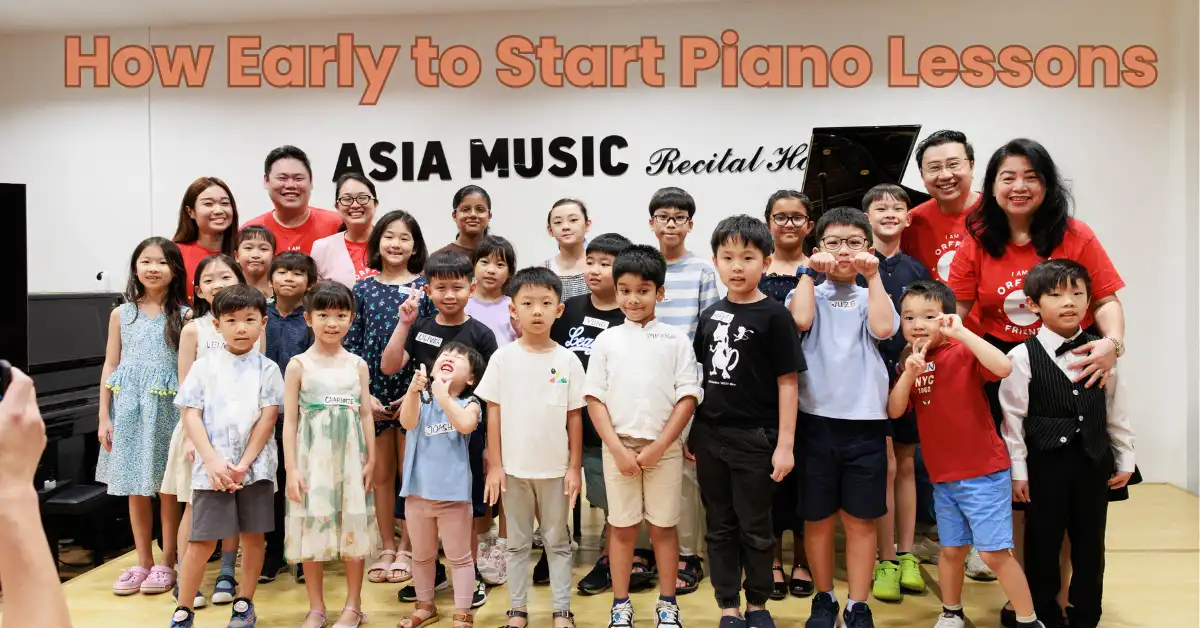
How early to start piano lessons?
For formal piano lessons, many children are ready around 4 to 7 years old, depending on their attention span, coordination, ability to follow instructions, and interest in music.
There is no need to rush a child into formal lessons simply because another child has already started.
Local music schools in Singapore use different age ranges. For example, some offer early-childhood music programmes from age 3, while instrumental programmes may begin around age 6. Other Bukit Timah studios accept piano beginners from around age 4.
Is 3 years old too young for piano?
Not necessarily, but formal piano instruction may not be the best starting point for every 3 year old.
At this age, children can explore rhythm, pitch, movement, singing, listening and basic keyboard concepts without being expected to sit through a traditional lesson and practise scales or pieces.
For example, Gail’s Piano Studio’s Orffie Explorers programme is designed for children aged 18 months to 3 years and includes parent-accompanied musical activities. Its next stage, Orffie Scholars, is for ages 3 – 4.
This approach can make sense when the goal is to build familiarity with music before expecting a child to learn piano in a more structured way.
Think exposure first, formal technique later.
What about starting at age 4 or 5?
For many children, this can be a comfortable transition into more focused piano learning.
A child around this age may be able to:
Follow simple instructions
- Sit and participate for a short lesson
- Recognise differences in pitch and rhythm
- Copy simple patterns
- Use both hands in basic activities
- Remember short musical instructions
- Show curiosity about the piano
- Enjoy repeating an activity to improve
But there is an important distinction between being physically able to play piano and being ready for a particular teaching style.
A 4-year-old may thrive with games, movement, and short activities but struggle with a traditional 30- or 45-minute lesson focused heavily on notation.
That does not mean the child is “not musical.” It may simply mean the learning approach needs to match their stage.
Signs your child may be ready for piano lessons
Instead of looking only at age, look for readiness.
1. They show interest in music
Do they sing along to songs, tap rhythms, dance to music, or ask to play the piano?
Curiosity is a useful starting point.
2. They Are Developing Their Attention Span
A young child does not need to have a long attention span before starting music classes. Developing focus and attention is part of the learning journey.
Through activities such as listening, singing, rhythm games and movement, children learn to stay engaged, follow simple instructions and gradually focus for longer periods.
This is one of the key areas developed in Orffie Explorer and Scholar classes, alongside their musical skills. Children learn to listen, concentrate and take part in structured activities in a way that feels natural and enjoyable.
They do not need to sit still or concentrate for long periods from the beginning. What matters is that they can listen, participate, and respond to simple instructions, with their attention developing over time.
3. They enjoy repetition
Learning an instrument involves doing something more than once.
If your child enjoys trying the same musical game or song repeatedly, that can be a positive sign.
4. They can participate without constant pressure
A child does not need to sit perfectly still.
However, if every lesson becomes a struggle, forcing formal piano training may create unnecessary frustration.
5. They are interested in making sounds themselves
Some children naturally experiment with keys, rhythms, and melodies. That curiosity can be more meaningful than whether they already know musical notes.
What if my child is 6, 7 or 8?
It is not too late.
Children usually have better finger control at this stage, which helps them play their first simple piano song from their very first lesson.
They also begin to develop their own musical preferences and can take part in choosing the songs they want to learn. Having a say in what they play can help keep them interested and motivated. With guidance from their teacher, they can also start setting simple musical goals of their own.
Older beginners can bring different strengths to piano learning. They may have a longer attention span, better ability to understand instructions, and greater independence during practice.
Several Singapore music schools accept beginners well beyond the preschool years. Gail’s Piano Studio, for example, offers beginner piano learning for children aged 7 and above.
So parents should not feel that their child needs to start at 3 or 4 to have a meaningful musical education.
Starting later can still be a positive beginning.
Should you choose group classes or private piano lessons?
This depends partly on the child’s age and personality.
Group classes
Group classes can work particularly well for younger children when the programme uses singing, movement, rhythm games and shared musical activities.
They can also make music feel social rather than like another academic subject.
Private lessons
One-to-one lessons provide more individual attention and can be useful when a child is ready for structured piano technique, repertoire, reading music or examination preparation.
For younger children, however, a private lesson is not automatically better simply because it is individual. The teaching approach still needs to suit the child’s developmental stage.
The key question is:
Will my child learn best through play, group interaction, individual instruction, or a combination?
When should a child start learning piano for ABRSM?
If your family has a longer-term goal of taking ABRSM examinations, starting at a suitable age can give your child more time to develop gradually.
But there is no need to make examinations the first objective.
A young child can first develop:
- Rhythm
- Listening
- Musical vocabulary
- Keyboard familiarity
- Coordination
- Confidence
- Basic technique
Formal grades can come later when the child is ready for that style of learning.
The right progression is often more useful than simply starting as early as possible.
What should parents look for in a Bukit Timah piano studio?
If you live around Bukit Timah, Beauty World, Upper Bukit Timah, or nearby areas, convenience matters, but it should not be the only factor.
Look for a programme that offers:
Age-appropriate teaching: A lesson designed for a 3-year-old should not simply be a shortened version of an adult beginner lesson.
A clear learning pathway: Ask what happens after the introductory programme. Where does the child go next?
A balance of enjoyment and structure: Children need both. Too much pressure can reduce enjoyment, while too little structure can make progress difficult.
Qualified, suitable teachers: Ask about the teacher’s training and experience with young children, not only their piano qualifications.
A chance to try the programme: A trial class can tell you more than a brochure. You can observe how your child responds to the teacher, environment and activities.
Gail’s Piano Studio is located at Bukit Timah Shopping Centre and offers trial classes so parents can experience the programme before deciding whether it suits their child.
The most important question: Is your child ready?
If you are wondering whether your child should start piano at 3, 4, 5, 6, or 7, avoid treating the age number as the entire answer.
Ask yourself:
Does my child enjoy music?
Can they participate in a short structured activity?
Are they curious about the piano?
Would they respond better to play-based learning or formal instruction?
Does the teacher understand how young children learn?
Those answers can tell you much more than age alone.
Conclusion
So, how early to start piano lessons?
For many children, formal piano learning can begin around 4 to 7 years old, while younger children can start with music-based activities that build rhythm, listening, and coordination.
The goal should not be to start at the youngest possible age. Instead, find a learning experience that matches your child’s development, interests, and personality.
For parents in Bukit Timah, a trial class can be a simple way to see whether your child is ready and which type of programme suits them best.
FAQs
What is the best age to start piano lessons?
Many children are ready for formal piano lessons around 4 to 7 years old. Younger children can begin with play-based music classes, while older beginners can start successfully at 7 or beyond.
Can a 3-year-old learn piano?
Yes, but the learning approach matters. At 3, play-based music, rhythm, movement and introductory keyboard activities may be more suitable than traditional formal piano instruction.
Is 5 a good age to start piano?
Yes. Many 5-year-olds can begin structured beginner piano learning, particularly when they can follow simple instructions, participate in lessons, and show interest in music.
Is 7 too late to start piano?
No. A child can start piano at 7 or later without needing previous musical experience. Older beginners may be ready for more structured instruction from the beginning.
Does my child need a piano at home?
If your child is just starting piano lessons, you may not be sure how long their interest will last or how regularly they will practise. That’s completely normal!
For beginners, a budget-friendly digital piano can be a practical place to start. It usually costs less than an acoustic piano and takes up less space at home.
As your child’s interest grows and they develop a regular practice habit, you can consider upgrading to an acoustic piano. An acoustic piano offers a wider range of tone and expression, allowing your child to explore more as their playing develops.
Should my child take piano exams?
Not necessarily. Examinations can provide a structured goal, but children can also learn piano for enjoyment, musical development, and performance without following an examination pathway.